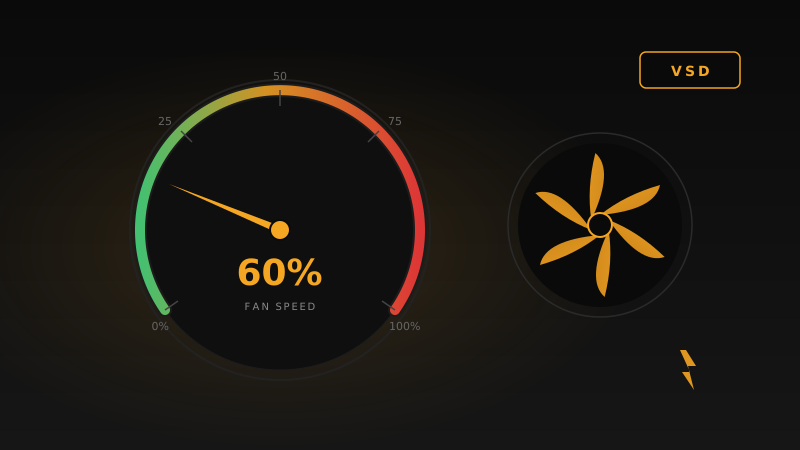
Commercial kitchen exhaust fans are the workhorses nobody thinks about. They run for 12 to 18 hours a day at a single flat speed, regardless of whether the kitchen is flat-out during dinner service or ticking over with two breakfast orders. Every hour they run at full speed when they do not need to is money going straight to the switchboard meter.
A variable speed drive (VSD, also called a VFD) can let a suitable fan motor operate at different commissioned speeds. On the right existing system, this can reduce energy use, soften starting and provide better control without replacing the canopy or ductwork.
Suitability, savings and scope are site-specific. The motor, fan, controls, make-up air and required cooking-mode airflow all need to be considered before a retrofit is recommended.
What a VSD Actually Does
A variable speed drive sits between the electrical supply and a compatible exhaust fan motor. It varies output frequency so the motor can operate within a speed range selected during design and commissioning.
Instead of being stuck with a single on/off fan, you get a dial. When the kitchen is quiet, the fan runs at 50% and draws a fraction of the power. When the char-grill gets fired up, it ramps to 100% in a couple of seconds.
The reason this can matter for fans is a relationship described by the affinity laws. For an ideal fan system, power changes approximately with the cube of speed. Actual results also depend on motor and drive efficiency, system resistance, control settings and operating conditions:
| Fan speed | Airflow | Power draw |
|---|---|---|
| 100% | 100% | 100% |
| 80% | 80% | ~51% |
| 60% | 60% | ~22% |
| 50% | 50% | ~13% |
The table illustrates the theoretical relationship. It is not a guaranteed site saving, and the fan must not be reduced below a setting that maintains the required performance for the operating mode.
What a Realistic Saving Looks Like
Take a mid-sized restaurant with a 3 kW exhaust fan running 14 hours a day, 6 days a week, at a commercial tariff of around $0.35/kWh.
Before VSD: fan runs at 100% the whole time:
- 3 kW × 14 h × 6 d × 52 w = ~13,100 kWh per year
- That is roughly $4,600 per year in exhaust fan electricity alone.
After VSD: fan averages around 65% speed across the day (full speed during service, ramped down outside peak):
- Average power draw drops to ~28% of rated = ~0.84 kW
- 0.84 kW × 14 h × 6 d × 52 w = ~3,670 kWh per year
- Annual cost: ~$1,280
Illustrative saving: approximately $3,300 per year. This example assumes the stated operating profile and an idealised power relationship. It does not include all motor, drive or system losses.
Actual savings and payback depend on fan size, motor suitability, tariff, trading hours, control strategy, installation cost and the minimum speed the kitchen can safely use while operating. These should be assessed before relying on a business case.
Secondary Benefits Beyond the Power Bill
The electricity saving is the headline, but it is not the only thing a VSD brings:
- Less wear on the motor and belts. Soft-starting at reduced frequency eliminates the inrush-current slam that kills motors and shreds drive belts over time.
- Quieter kitchen. Anyone who has worked under a flat-out exhaust fan knows the difference when it drops to 60%. Staff conversation becomes possible; noise complaints from neighbours drop.
- Smoother makeup air. Pressure balance in the kitchen becomes more stable, reducing the door-slamming and odour back-draw problems that plague oversized systems.
- Commissioned speed control. A VSD can help tune airflow on a suitable system, but settings must be supported by measurements and the applicable design requirements.
A VSD is not a repair for worn belts, bearings or motors. If the fan has stopped, become noisy or started vibrating, begin with commercial exhaust fan fault diagnosis and repairs before assessing a control upgrade.
What a Retrofit Actually Looks Like
A typical retrofit on an existing exhaust fan takes one day on-site. The job is:
- Isolate the supply, remove the existing motor starter.
- Install the VSD in the switchboard or in a dedicated enclosure close to the motor.
- Wire the motor through the drive, including any required EMC filter and output reactor for long cable runs.
- Configure motor parameters, set speed ranges and ramp times.
- Add a simple control interface, either a wall-mounted keypad, a switch-selectable high/low, or (better) an automated schedule.
- Commission with actual airflow measurement to confirm the kitchen still meets its design extract rate at its chosen speeds.
The final commissioning step must not be skipped. A VSD is only useful if the selected operating modes still provide the required performance when cooking is taking place.
Controls and Optional Monitoring
Once a VSD is installed, the control method determines whether the expected operating pattern is actually followed. Common strategies include:
- Manual high/low switch: reliable, but depends on staff remembering to use it.
- Time-of-day schedule: good for predictable hours, clumsy when trading hours change.
- Demand-based control: the drive ramps automatically based on duct temperature, pressure, or cooking activity. Best results, most configuration.
Compatible monitoring may record drive frequency, current, runtime and fault history. Those values can support maintenance and energy review, but they do not directly measure airflow or guarantee savings. Monitoring options are subject to the installed drive, control design and product availability.
A VSD is worth assessing when the existing fan spends long periods operating above the airflow needed for that operating mode, the motor is suitable and there is a practical control strategy. It is not automatically the right answer for every kitchen.
Considering a VSD retrofit? View our VFD, controls and interlocks service or call 0423 063 061. A multi-fan Assessment & Report is $450 + GST. The assessment fee is waived if quoted remedial or replacement work proceeds.
Energy figures are illustrative only. Actual results depend on equipment, measured airflow requirements, hours, tariff, control strategy and system condition. Technical and compliance requirements must be confirmed for the specific site.